FAA Part 107 and Infrastructure Inspection: What Asset Owners Actually Need to Know
A non-pilot's guide to FAA Part 107 — what it covers, where the limits matter for infrastructure work, when waivers come into play, and what asset owners should verify before a drone provider arrives on site.
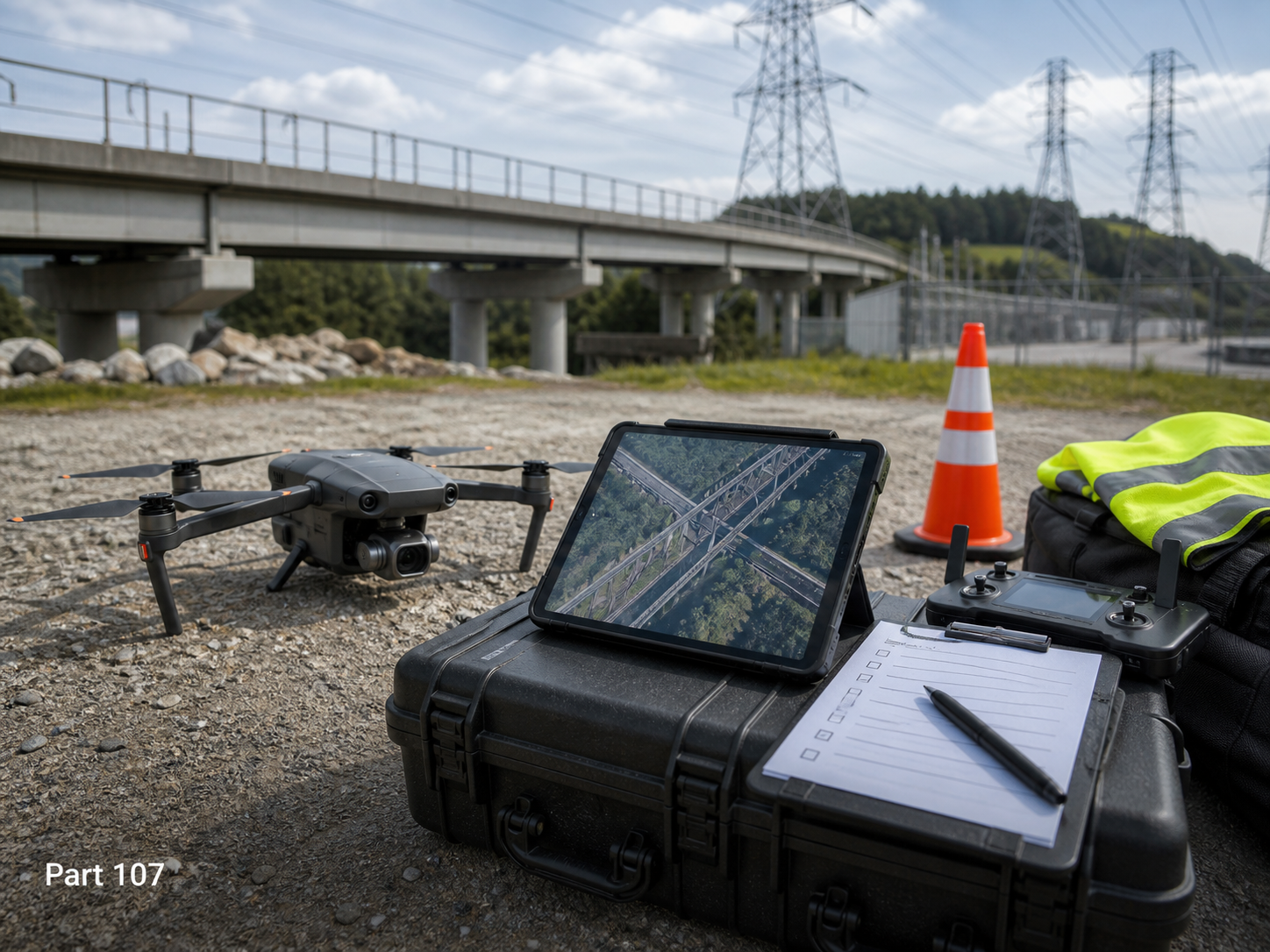
Asset owners commissioning drone work do not need to memorise FAA regulations. They do need to know enough to ask the right questions, identify when a provider is operating cleanly, and recognise the situations where standard Part 107 rules are not enough on their own.
This is a working guide written for the person procuring or hosting drone services on critical infrastructure — not for the pilot. It focuses on the points that affect scope, safety, and project risk.
What Part 107 covers, in plain terms
14 CFR Part 107 is the FAA rule that governs small unmanned aircraft system (sUAS) operations in the US for any flight that is not purely recreational. Almost all commercial drone inspection work falls under Part 107.
In practice, a Part 107 operation has four operating limits that matter for infrastructure work:
- Maximum altitude: 400 feet above ground level, or up to 400 feet above a structure if flying within 400 feet of it. For most pipeline, substation, and corridor work, this is not a constraint.
- Visual line of sight: the pilot or a designated visual observer must keep the aircraft in unaided sight at all times. This is the constraint that most often forces waivers or operational adjustment.
- Daylight or civil twilight operations: night flights are allowable under Part 107 with anti-collision lighting, but require additional planning.
- No flight over people without specific category waivers in place.
The pilot must hold a current Remote Pilot Certificate, which requires passing the FAA Unmanned Aircraft General knowledge test and completing recurrent training every 24 months. Both should be verifiable on request.
Why visual line of sight matters more than asset owners expect
VLOS is the operating constraint that shows up most often in infrastructure scoping conversations, because long linear assets like pipelines and transmission corridors do not match the human eye’s effective range.
“On a pipeline corridor, the deliverable might cover 30 miles. The pilot can see the aircraft for maybe half a mile, depending on weather and aircraft size,” says Hunter Gray, founder of Overwatch Mapping. “So a 30-mile corridor is not one flight, it is sixty flights with re-positioning. The economics, the timeline, and the scope all flow from that constraint, not from what the drone can theoretically do.”
There are two ways to handle this. The first is to plan the work as a sequence of VLOS legs with visual observers leapfrogged along the route — slower, but no waiver required. The second is to apply for a Beyond Visual Line of Sight (BVLOS) waiver, which the FAA grants case-by-case for operators with the equipment, procedures, and safety case to support it.
Asset owners should know which approach the provider is taking before the work starts. The difference shows up in timeline, cost, and the documentation that needs to be in place.
Controlled airspace and infrastructure
A substantial amount of US infrastructure sits inside controlled airspace — particularly assets near airports, military installations, or major metro areas. Part 107 flight in Class B, C, D, or surface E airspace requires either pre-authorisation through LAANC (Low Altitude Authorization and Notification Capability) or a written FAA authorisation.
For most planned infrastructure work in controlled airspace, LAANC is the right tool — authorisations are typically issued within seconds for altitude grids the FAA has pre-approved. A provider should be able to:
- Identify the airspace class for every flight in the project at scoping.
- Show LAANC authorisations or pending authorisations before the day.
- Have an alternative plan if authorisation is denied or restricted.
If the project site is in Class B or surface-level controlled airspace with no LAANC grid, the provider may need to apply for written authorisation, which can take weeks. That timeline needs to be inside the project plan from the start.
Where Part 107 is the floor, not the ceiling
For infrastructure inspection work, Part 107 compliance is the legal minimum. Asset-owner site requirements almost always add more.
Substation work typically requires the operation to integrate with the asset owner’s safety system — switching plans, agreed offsets, escort requirements, and outage windows. Construction site work requires inductions, PPE compliance, and integration with the principal contractor’s safety plan. Sensitive sites (refineries, ports, government facilities) often require additional clearances on top of Part 107.
“The FAA tells you what is legal to fly,” Gray notes. “The asset owner tells you what is acceptable on their site. Those are different documents, and any serious provider should be talking about both at scoping, not one of them on the day.”
A provider operating purely to the Part 107 minimum on a critical infrastructure site is operating to the wrong standard.
Remote ID — what it is and why it matters
As of 2024, most drones operating under Part 107 must broadcast Remote ID, a unique identifier and position transmitted in real time. This is now a baseline expectation. Any commercial-grade drone purchased recently complies automatically; older equipment may require a broadcast module retrofit or operation in a FAA-Recognized Identification Area (FRIA).
For asset owners, the practical implication is small but worth checking: a provider operating non-compliant equipment in non-FRIA airspace is operating outside the regulations, and the legal exposure sits with both the provider and potentially the site host.
Insurance and Part 107
Part 107 does not require commercial drone operators to carry insurance. The FAA is a safety regulator, not a financial one. The market — and most infrastructure asset owners — fills that gap.
Standard expectations for infrastructure work include:
- General liability insurance, typically at least $1 million per occurrence.
- UAS aviation liability, specifically — many general policies exclude aviation incidents.
- Workers’ compensation for crew, where applicable.
- Hull coverage for the equipment, which protects the provider but indirectly affects schedule reliability.
Certificates of insurance should be available before any work begins, and asset owners should specifically check that aviation operations are not excluded under general liability.
A practical compliance checklist for asset owners
When commissioning drone work on infrastructure, verify the following before the provider mobilises:
- Pilot certification: Part 107 certificate number and expiry date for each named operator.
- Insurance certificates: general liability with aviation operations covered, plus UAS-specific aviation liability.
- Airspace plan: every flight location identified, with LAANC or other authorisation in hand.
- Operating approach: VLOS or BVLOS, with appropriate waivers documented if BVLOS.
- Remote ID compliance: equipment confirmed compliant or operation planned within a FRIA.
- Site integration: written confirmation of how the operation integrates with the asset owner’s safety system, induction, and access requirements.
These are not unusual asks. A provider who treats them as obstacles is the wrong provider for infrastructure work.
A final note on the regulatory environment
Part 107 is being actively expanded. The FAA has signalled continued movement toward enabling routine BVLOS operations under a future rule, which would meaningfully change how long-corridor infrastructure work is scoped. The current operating environment is the baseline; the trajectory is toward broader operational latitude with stronger documentation expectations.
“The compliance side of this is not optional, and it is not going to get simpler,” Gray says. “But it is becoming more enabling for the kind of long-asset, repeatable work that infrastructure owners actually want. The providers and asset owners who build clean compliance habits now will move faster as the rule set expands.”
For asset owners, the right question is not whether the rules are restrictive — it is whether the provider you have hired is operating cleanly inside them, with documentation that holds up under inspection.