The Business Case for a Drone Inspection Program: How to Frame ROI for Asset Owners
A practical look at how infrastructure operators measure return on investment from a drone inspection program — direct cost savings, avoided incidents, and the harder-to-quantify gains in decision speed.
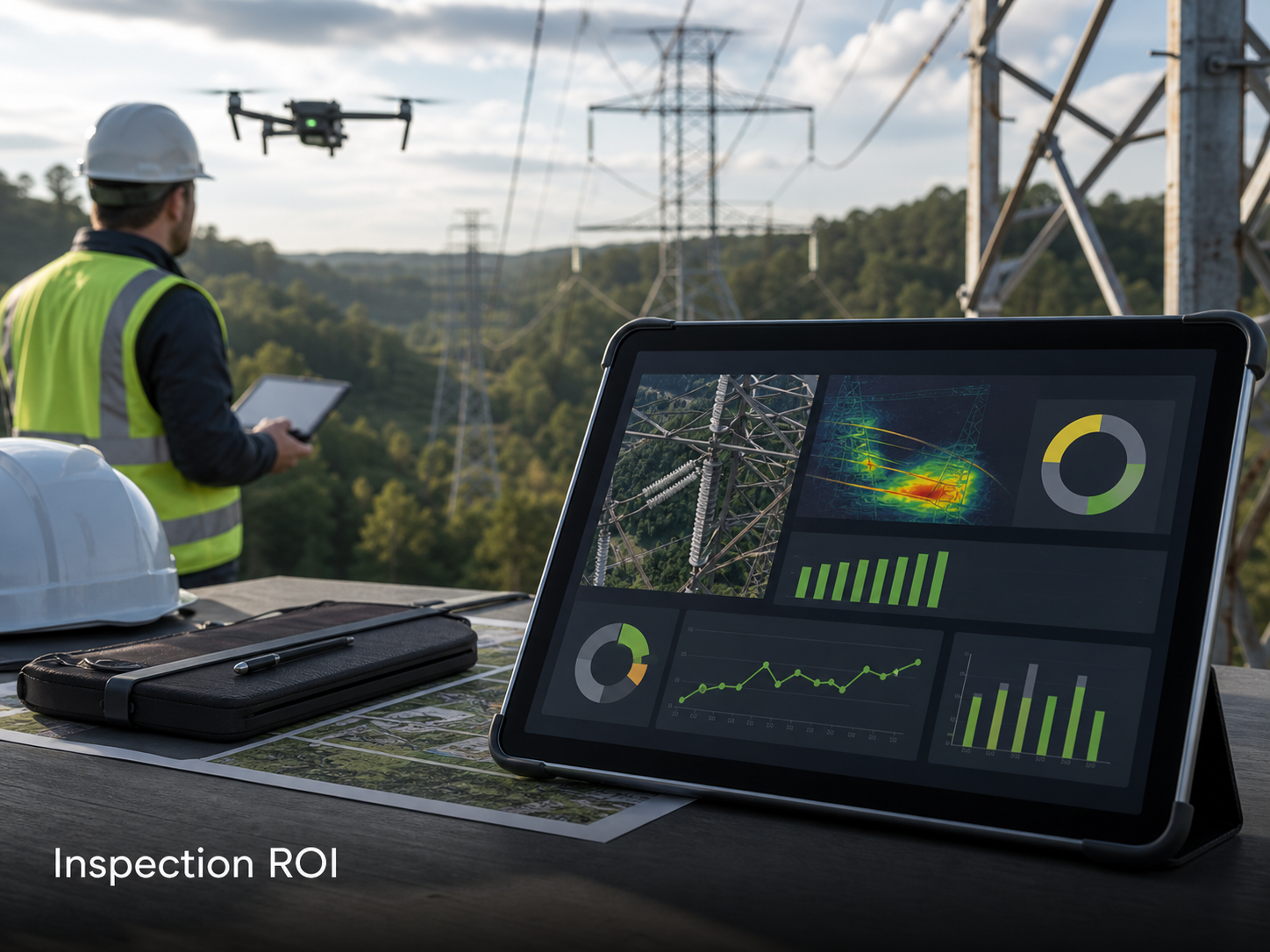
Most asset owners we work with do not need convincing that drones can produce useful field data. They need a defensible answer to a different question: is the program worth funding, and how do we explain the return in terms the finance team will accept?
This post is about how to frame that answer. It is not a pitch — it is a structured way to think about where the value actually sits, what gets counted, and what tends to be quietly understated when the case is built around flight-day economics alone.
Start with the decisions, not the deliverables
The cleanest ROI frame starts upstream of the data. Before counting hours or dollars, list the recurring decisions the field data is meant to support. Vegetation management priorities. Substation outage planning. Capital project sign-off. Compliance reporting. Encroachment response. Each of those decisions has a current cost — in time, in personnel exposure, in deferred maintenance, in delayed approvals.
“The mistake operators make in the business case is starting with the cost of the flight,” says Hunter Gray, founder of Overwatch Mapping. “The flight is the smallest line item in the program. The value is in how much faster a maintenance decision gets made and how much less rework happens because the underlying record is current.”
Once the decisions are listed, the ROI conversation has a foundation that is not dependent on counting drone hours.
The direct cost savings are easier to defend than people think
Several recent industry studies put numbers around the direct-cost side of the case. The Federal Highway Administration’s research on UAV bridge inspections shows savings of 30 to 50 percent in total inspection costs when drone capture replaces or supplements traditional methods. State DOT pilot programs have reported 40 to 60 percent cost reductions on comparable scope.
On the utility side, the numbers are similar. A utility spending $100,000 annually on manual pipeline inspections can typically reduce that to $35,000 to $50,000 by transitioning to drone services, with full ROI usually achieved within 6 to 12 months. A specific case from Macomb County, Michigan saw inspection costs drop from $1 million every three years to $100,000 using drones, with faster turnaround.
These are useful anchor points, but they are also the easy part of the case. The harder and more valuable side is what the data prevents.
The avoided-incident value is where the case really sits
Direct cost savings get a program funded. Avoided incidents are what justify expanding it. The clearest illustration comes from Pacific Gas and Electric, whose drone inspection program identified 847 potential failure points in 2022 alone. Proactively addressing them cost roughly $12 million — and prevented an estimated $340 million in downstream failure costs.
That ratio — small proactive spend against large avoided loss — is the pattern asset owners should be modelling for their own infrastructure. The inputs are imperfect (avoided losses are estimates, not invoices) but the order of magnitude is consistent across the published case studies.
“On critical infrastructure, the avoided-incident number almost always dwarfs the direct savings number,” Gray notes. “But operators are sometimes uncomfortable putting it in the business case because it feels speculative. Our view is that it is more defensible than the alternative — which is pricing in zero value for avoided failures and then explaining why a failure happened anyway.”
What the standard ROI model usually misses
Three categories of value are routinely under-counted in drone program business cases.
Personnel exposure. The labor hours saved are easy to count. The hours of personnel exposure to height, energised equipment, or remote environments avoided are harder, but they show up in safety statistics and incident rates. A program that eliminates one high-risk climb per month does not just save labor — it removes a recurring source of incident risk.
Decision latency. Traditional aerial damage assessment often waits 3 to 7 days for commercial contractors, while same-day drone reconnaissance is now standard. The dollar value of compressing that timeline depends on what decision is waiting on the data — in a storm response scenario, it can be the difference between a same-week recovery and a regulatory escalation.
Record consistency. A drone program builds a comparable visual record over time. The second flight is worth more than the first, and the fifth is worth more than the second, because the change-over-time data starts to drive decisions on its own. This compounding value almost never appears in the year-one business case but is the reason mature programs renew.
A practical structure for the business case
A defensible business case for a drone inspection program usually has five sections:
- Decisions the program supports — name the recurring maintenance, compliance, or capital decisions that will be informed by the data.
- Direct cost comparison — current method cost (labor, equipment, downtime) versus drone-program cost, with realistic ramp assumptions in year one.
- Avoided-incident modelling — a small number of credible scenarios with probability and cost estimates, drawn from the asset owner’s own incident history where possible.
- Programmatic value — repeatability, decision speed, personnel exposure reduction. These are qualitative or semi-quantitative but they belong in the case.
- Year-by-year ramp — most programs reach full value in year two or three, not year one. The case should show that curve, not promise immediate maturity.
If the case is built on direct savings alone, it tends to look modest and gets approved as a small pilot. If it is built on the full value picture — decisions, savings, avoided incidents, and program maturity — it gets funded as a capability investment.
A short note on what we tell first-time buyers
For asset owners commissioning their first drone program, the most common mistake is over-scoping the pilot. A pilot that tries to demonstrate every possible service ends up demonstrating none of them well, and the business case that comes out of it is weaker than a focused one would have been.
“Pick one asset class, one recurring decision, and one measurable outcome,” Gray suggests. “Run the program for two cycles, measure the outcome against the prior baseline, and let that result drive the expansion conversation. Operators who try to prove everything at once usually end up proving nothing.”
The full-program value case is built one focused outcome at a time. The numbers above are anchors. The defensible case is the one grounded in the operator’s own decisions, history, and assets.